



Retainers and clear aligners are among the most paradoxical products in dentistry. They can be relatively expensive and require exceptional precision, yet patients often store them in surprisingly careless ways. Some wrap them in a tissue and slip them into a pocket. Others leave them on the dining table before heading to the bathroom. By the time they return, the appliance may have been forgotten, misplaced, or even damaged under pressure.
For dental brands, what happens to a product after it leaves the factory depends, to a surprising extent, on its packaging.
The value of custom retainer packaging goes far beyond appearance. It serves four important functions: protecting the product, supporting hygiene, communicating brand identity, and encouraging consistent daily use. Understanding these four dimensions helps explain why more dental brands are looking beyond generic plastic cases with a simple logo sticker.
The precise geometry of retainers and clear aligners is essential to their intended function. Upper and lower appliances have distinct shapes, and each aligner in a treatment series may differ as the patient's teeth move through successive stages. For manufacturers handling multiple products, packaging must accommodate a range of dimensions rather than a single fixed size.
An oversized internal cavity allows the appliance to move around and potentially collide with the case during transit. A cavity that is too tight, on the other hand, can make removal difficult and increase the risk of scratching the surface.
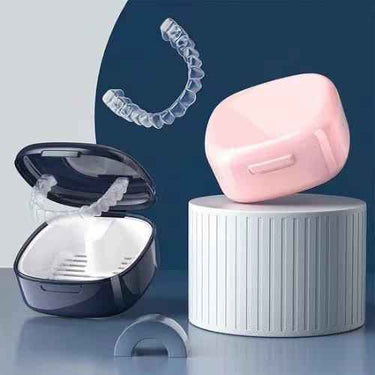
This is where custom retainer case design makes a difference. Molded compartments or strategically positioned cushioning ribs can help keep each appliance in place, reducing movement and helping absorb external pressure rather than transferring it directly to the product.
For dental brands shipping products directly to patients, the strength of the outer mailer and the positioning of internal supports are equally important. A retainer traveling through sorting facilities, conveyor systems, and stacked parcels faces far more demanding conditions than one sitting in a clinic drawer.
Well-designed custom dental packaging should therefore consider both the dimensions of the appliance and the conditions it may encounter during storage and transportation. The goal is not simply to fit the product inside a box, but to help it arrive in the intended condition.

For products that come into contact with the mouth, packaging hygiene is a fundamental consideration. Protection against dust, moisture, and secondary contamination helps maintain product cleanliness during storage and distribution.
Retainers may be cleaned before leaving the production facility, but unnecessary exposure to dust or moisture during transportation can compromise the cleanliness of the product and the patient's first impression. Appropriate packaging materials and closure structures can provide a basic physical barrier against environmental exposure before the appliance reaches the user.
One detail deserves particular attention: the balance between ventilation and closure.
During everyday storage, a completely airtight retainer case may trap residual moisture if the appliance is put away before it has dried adequately. Depending on the appliance, storage conditions, and cleaning routine, trapped moisture can contribute to unpleasant odors and create conditions favorable to microbial growth.
A well-designed retainer case should account for its intended use. Ventilation openings can help air circulate during everyday storage, while a secure closure helps protect the appliance from physical contact with surrounding objects. The appropriate design depends on whether the case is intended for routine storage, travel, or packaging a clean appliance for distribution.
These functions should not be confused. Ventilation does not replace cleaning, and a standard storage case should not automatically be treated as a sterile barrier. Instead, material selection, case structure, cleaning instructions, and the intended storage environment should work together to support good hygiene practices.
This seemingly small design decision distinguishes a case that merely holds an appliance from one designed around the realities of daily use.
A dental brand's positioning can be communicated through packaging details long before a patient reads a product brochure or visits a website. Surface finishes, colors, textures, and logo treatments all contribute to the way a product is perceived.
Brands with a clinical, professional identity may prefer molded matte surfaces, white or pale blue color schemes, and restrained typography. These choices can create a clean, understated appearance that aligns with a healthcare-focused brand.
Direct-to-consumer brands targeting younger audiences may instead explore glossy finishes, brighter colors, or more expressive visual elements. Boutique and premium brands might consider pearlescent coatings, while limited-edition collections or high-impact product launches may benefit from metallic finishes or vacuum metallization.
For brands that rely on distinctive graphics, full-coverage decoration and water-transfer printing can offer additional design possibilities. The right option depends on the desired visual effect, the case material, the product's geometry, and the overall brand identity.
Importantly, surface finishing should not be treated as an afterthought once the case structure has been finalized. Coating adhesion, abrasion resistance, fingerprint visibility, and long-term appearance can all be influenced by the material and shape of the outer shell.
The more reliable approach is to evaluate structure, material, and finish together during prototyping. This allows the brand and manufacturer to assess the complete product rather than selecting individual elements in isolation and attempting to combine them later.
For B2B buyers exploring custom retainer cases, early collaboration on color, finish, logo placement, and mold design can also help establish a more consistent packaging system across product lines.

The effectiveness of retainer treatment depends in part on following the wearing schedule recommended by the dental professional. Even a comfortable retainer can become inconvenient to manage when patients are eating out, working in an office, or traveling.
A properly sized portable retainer case gives patients a designated place to store their appliance when it needs to be removed. Instead of wrapping it in a tissue or leaving it on a table, they have a practical storage solution that can be carried in a handbag, backpack, or travel kit.
The design should be simple but dependable. A secure closure helps prevent accidental opening, a suitably sized interior makes placement and removal easier, and a surface that is easy to clean supports regular maintenance.
Research comparing different types of retainers has examined patient comfort and other treatment-related outcomes. However, comfort findings alone do not establish that a particular case design improves compliance. The more practical point is that convenient storage can help address an everyday challenge patients face when managing their appliances outside the home.
From a branding perspective, the retainer case is also one of the most frequently handled physical touchpoints throughout the treatment period. Patients may open and close it repeatedly, carry it between locations, and keep it alongside other personal belongings.
That makes the case more than a simple accessory. It becomes part of the patient's daily experience with the brand. When patients place the case in their bags, take it to work, or pack it for a trip, the brand becomes part of their routine rather than remaining limited to the initial delivery at a dental clinic.
For dental businesses, custom orthodontic packaging offers an opportunity to connect practical usability with brand recognition. The case does not need an elaborate design to make an impression. It needs to be reliable, convenient, and consistent with the product it accompanies.
Which surface finish best suits your brand? The answer depends on your target audience, product positioning, and intended use rather than the number of finishing techniques available.
Clinical and professional positioning: Start by evaluating molded matte surfaces and restrained color palettes.
Youth-oriented retail brands: Compare molded glossy finishes with high-gloss coatings to find the right balance between visual impact and durability.
Tactile brand experiences: Consider soft-touch coatings and assess their resistance to wear, fingerprints, and repeated handling.
Premium and boutique collections: Explore pearlescent finishes for a distinctive appearance.
High-impact product launches: Consider metallic paint or vacuum metallization when the material and production process support the desired effect.
The best results come from following a clear development process: finalize the structural requirements first, evaluate material and surface options together, validate the design through prototypes, and confirm performance before moving into mass production.
Packaging may not be the central product of a dental brand, but it is one of its most tangible brand statements.
A case that helps protect an appliance during transportation, supports appropriate everyday storage, and feels natural to carry communicates something meaningful about the company behind it. It shows that the brand has considered not only how the product is manufactured, but also how it will be handled, stored, and used in real life.
For dental brands, investing in custom retainer packaging is therefore an opportunity to bring product protection, practical design, and brand identity together in one everyday item.
At PINES, custom packaging development can help dental and personal care brands explore case structures, materials, colors, surface finishes, and logo customization to suit their product requirements and brand positioning. A well-designed retainer case does more than hold an appliance. It helps connect the product to the patient's daily routine and gives the brand a lasting physical presence.

