



In the health and wellness market, the pill organizer is a product category that has long been underestimated. It does not rely on complicated electronics or cutting-edge materials. Instead, it addresses a simple but frequent and essential daily need: taking medication and supplements on schedule.
Within this category, the pink pill organizer has developed into an interesting niche of its own. It solves two problems at the same time: making daily medication management more convenient while also making the experience feel more approachable and personal.
For years, traditional pill boxes have followed a distinctly medical design language: transparent, white, gray, and deliberately neutral. The underlying idea is that medication is something that should be kept discreet and out of sight. The growing popularity of the pink pill box challenges that assumption.
A bright-colored pill organizer solves a very practical problem first: visibility. On a cluttered nightstand, inside a drawer, or at the bottom of a travel bag, a pink pill organizer is much easier to spot than a transparent one. This is not simply a matter of personal taste. It directly affects ease of use.
Pines' recommendations for vitamin storage emphasize placing an organizer somewhere users regularly see it, such as on a dining table, nightstand, or in the bathroom. A visually distinctive organizer can therefore work as a simple visual reminder to take medication or supplements.
More importantly, a pink pill organizer can make the experience feel less clinical. As daily medication and supplement use increasingly becomes part of a regular wellness routine, users' expectations of the products around them are also changing. A pill box is no longer necessarily something that needs to be hidden away. It can become an everyday item that comfortably sits on a desk, bedside table, or bathroom counter.
As Wallpaper* has highlighted in its coverage of design-focused pill organizers, even highly practical objects can be elevated through thoughtful design. Function and form do not have to compete with each other. Pink is one of the clearest ways to express that idea in a product that is traditionally associated with clinical use.

Within the pink pill organizer category, different shapes correspond directly to different usage scenarios.
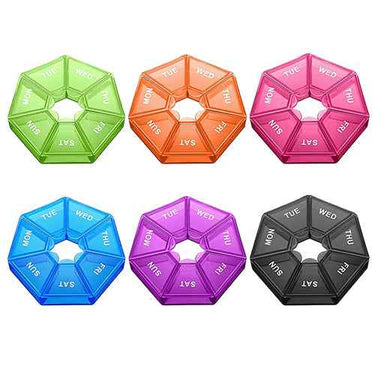
The round rotating pill organizer is one of the most recognizable formats. A typical seven-compartment round pill box is around 9 cm in diameter and uses a rotating top that allows users to align the lid with the desired compartment. Its main advantage is ease of one-handed operation, combined with a clear visual representation of the seven-day cycle.
Users do not have to open every compartment individually. The rotating motion itself creates a simple and intuitive routine for accessing medication. The rounded shape also avoids the sharp corners of conventional rectangular boxes, making it comfortable to carry in a pocket or bag.
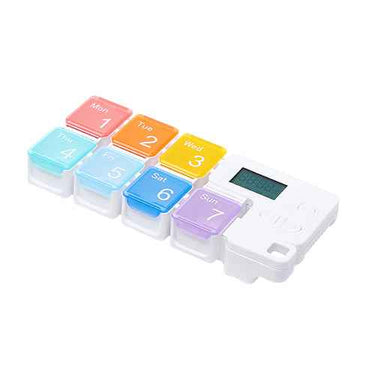
Square and flat stackable pill organizers serve a different purpose. Modular organizers allow users to combine individual compartments according to the number of days or doses they need. Magnetic stacking mechanisms can help keep multiple units aligned inside a bag instead of allowing them to separate and move around.
The logic behind this design is flexibility. Someone who needs medication for two days can carry two modules, while someone preparing for a full week can take seven. Pines' product range includes portable vitamin and supplement storage solutions designed around different daily, weekly, and monthly routines.
Neither format is inherently better than the other. They simply address different medication schedules and travel habits. A round organizer works well for users with a consistent daily routine, while a square, stackable design can be more suitable for people managing multiple doses or needing greater flexibility.
The central challenge of pill organizer design has always been the balance between capacity and size.
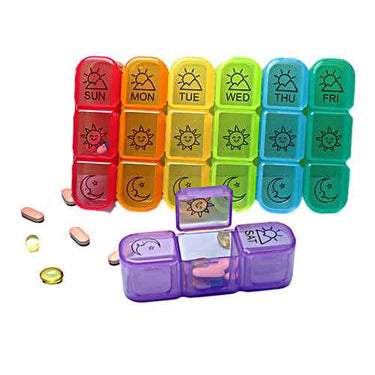
The term "7-day large capacity" is relative. For users who only take small vitamin tablets, seven compartments may provide more than enough space for a full week. For people taking larger supplements such as fish oil or calcium tablets, however, the actual usable capacity of each compartment becomes much more important than simply counting the number of compartments.
Holii's travel pill box, for example, uses a 6+2 compartment configuration: six smaller compartments for regular tablets and two larger compartments for vitamins or larger supplements. This asymmetric structure is closer to real-world use than simply dividing a pill box into seven identical sections.
At the opposite end of the spectrum is the mini portable pill organizer. Some designs reduce the size to approximately 15 cm long, 3 cm wide, and 2.5 cm thick, with a weight of only around 10 grams. Stackable and water-resistant structures make this type of organizer suitable for people who want to carry medication or supplements with minimal bulk.
The target scenario is simple: a commuter bag, gym waist pack, or even a suit pocket. Users do not need to make a special effort to remember the organizer because the organizer itself takes up so little space.
This is also where Pines' portable vitamin organizers have an advantage. Instead of carrying bulky supplement bottles, a lightweight organizer makes it easier to manage daily supplements while keeping them convenient to carry.
Ultimately, the right balance between capacity and portability depends on the user's primary routine. Is the organizer mainly intended for regular medication storage at home, or is it designed for taking supplements and medication on the go?

A pill organizer with a cutter is an integrated product direction that deserves more attention.
People who need to split tablets generally have a clear reason for doing so. Their dosage may need to be adjusted precisely, or they may find certain larger tablets difficult to swallow. When the pill box and pill cutter are separate, the user has to manage an additional step and carry another item.
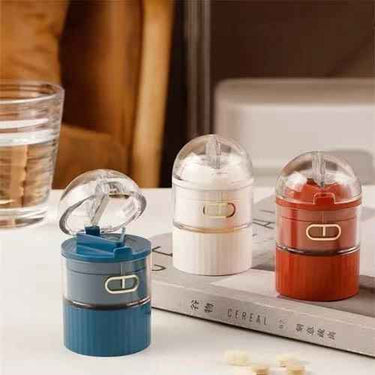
A three-in-one or four-in-one pill organizer changes that experience by combining storage, tablet splitting, and even grinding functions within a single physical unit.
From a product-design perspective, adding a pill cutter changes the entire usage process. The user is no longer simply taking a tablet out of a compartment. Instead, the organizer can support a complete sequence, from adjusting the tablet to preparing it for use.
This level of integration can also increase the product's practical value. A standalone pill cutter can easily be left at home or forgotten during travel. When the cutter is built directly into the pill organizer, it is available whenever the user needs it.
However, the cutting mechanism requires considerably more attention to structural design than a standard storage compartment. Safe blade positioning, accurate tablet alignment, and easy cleanup after splitting are all important details that affect the user experience.
Pines' product line includes pill organizers with integrated tablet-splitting functionality. In essence, this design adds a precision-tool function on top of basic storage. As a result, it requires higher standards in mold precision and material selection during manufacturing.
Packaging is often overlooked when developing a pill organizer, but it has a direct influence on how consumers perceive the product's positioning.
There are generally two common packaging approaches. One uses a simple paper box that emphasizes the product's practical and healthcare-related functions, with specifications and key features clearly displayed on the package.
The other approach makes the packaging part of the overall product experience. For example, some organizers are presented in reusable storage pouches or PU leather cases. The logic is straightforward: if the pill organizer itself is an item that users carry and display every day, its packaging should reinforce the same sense of portability and usability.
For a pink pill organizer, color consistency between the product and its packaging is particularly important. If the organizer has a soft cherry-blossom pink finish but the packaging uses a highly saturated fluorescent pink, the visual experience can feel disconnected.
Color accuracy can be especially sensitive in health and wellness products because color influences expectations around softness, everyday usability, and a less clinical appearance.
From an independent-site perspective, packaging also contributes to the unboxing experience. A thoughtfully designed package can make the product more visually appealing and more suitable for photography and social sharing.
In the health category, consumers may be less inclined to share their purchases than they are with beauty or fashion products. However, when a product looks attractive, practical, and appropriate for everyday life, the barrier to sharing it becomes significantly lower.
The reason pink pill organizers have become a lasting product category on independent sites is not simply the color pink itself. It is the signal that the color represents: this is a product that does not need to hide.
As medication and supplements become increasingly integrated into everyday wellness routines, the role of the pill organizer is also changing. It is moving from a purely medical accessory toward a more practical lifestyle tool.
Round, square, mini, stackable, and integrated pill-cutter designs all answer the same fundamental question: How can we make the small box that users need to open every day fit more naturally into the way they already live?

