



Splitting a tablet in half may seem like a simple task, but there is more to it than meets the eye. Some people split pills because they have difficulty swallowing them; others need to adjust their dosage, while some do it to reduce medication costs. However, not every tablet is suitable for splitting. Cutting the wrong type of pill can affect how the medication works and, in some cases, create serious safety risks.
For tablets designed with a score line, a pill cutter is generally the most practical tool for controlled splitting.
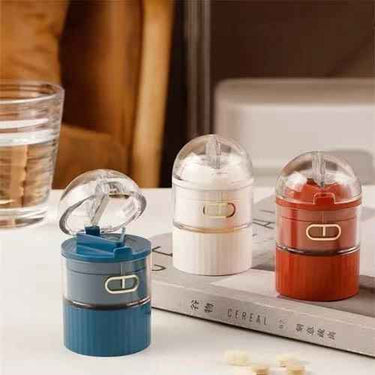
The basic design is simple. The tablet is placed into a V-shaped or U-shaped holder to keep it in position. When the lid is closed, the built-in stainless steel blade moves downward and cuts the tablet into two pieces. The split tablets then fall into the collection compartment below, making them easier to retrieve.
Splitting a tablet by hand makes it difficult to apply even pressure, which can cause the pill to crumble and result in uneven pieces. A regular knife may seem like another option, but it usually lacks a proper holder. The tablet can slip while cutting, the split may be uneven, and you also risk cutting your fingers.
The main value of a pill cutter comes down to two things: stability and control.
A V-shaped holder keeps the tablet securely in place, while the vertically positioned blade helps create a cleaner and more consistent split.

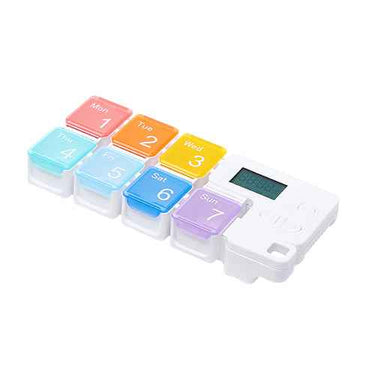
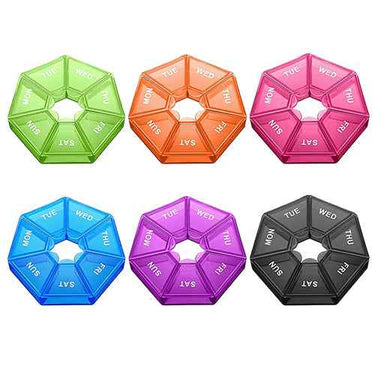
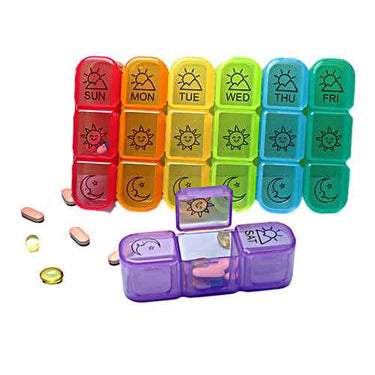
Today, many pill boxes and medication organizers with pill-cutting functions combine storage and tablet splitting in a single design. Different products use different features to make the process easier and more convenient.
1. V-Shaped Holder + Non-Slip Pad
This is one of the most common configurations.
The angled sides of the holder help guide the tablet toward the center, making it easier to align the blade with the tablet's score line. Some designs also include a silicone non-slip pad at the bottom of the holder to reduce movement during cutting and help produce two more evenly sized pieces.
2. Enclosed Blade + Safety Lock
In this design, the blade is enclosed within the cutting structure, reducing direct contact with the user's fingers.
Some models also include a locking mechanism to help prevent accidental opening, which can be particularly useful when the pill cutter is stored at home or carried while traveling.
3. Magnifying Glass for Better Positioning
For small tablets or users with limited eyesight, some pill cutters incorporate a magnifying glass into the lid.
This allows the user to see the score line more clearly and position the tablet more accurately before cutting.
4. Integrated Storage and Cutting
Some products take the concept further by combining several functions into one compact organizer.
A layered design may include a pill cutter on the first level, small compartments for storing split tablets on the second, and, in some models, even a small drinking cup as an additional function.
This type of multifunctional pill organizer with a cutter can make everyday medication management considerably more convenient.
The overall trend is clear: pill cutting is gradually moving from a delicate, trial-and-error task toward a more controlled and standardized process.

A score line is one of the first things to check. A line molded or pressed into the surface of a tablet may indicate that the manufacturer has designed it to be divided.
However, a score line does not automatically mean every tablet is safe to split. The product instructions and professional guidance should always take priority, because different formulations and manufacturers may use different release mechanisms.
Several types of tablets should not be split unless the product information or a healthcare professional specifically says that they can be divided.
1. Extended-Release and Controlled-Release Tablets
These tablets are designed with specialized structures that allow the active ingredient to be released gradually and consistently in the body.
Cutting or crushing them can disrupt the intended release mechanism and cause too much medication to be released too quickly, potentially increasing the risk of adverse effects.
A simple first step is to check the product name and labeling for terms such as extended-release, controlled-release, sustained-release, or modified-release.
If such wording appears, do not assume the tablet can be split simply because it has a score line. Check the official medication information or ask a pharmacist or doctor first.
2. Enteric-Coated Tablets
Enteric-coated tablets have a special coating designed to protect the medication from stomach acid or prevent the active ingredient from being released until the tablet reaches the intestine.
Splitting the tablet can damage this protective coating and cause the medication to be released in the wrong place. This may reduce its intended effect and, depending on the medication, may also irritate the stomach.
Common examples include enteric-coated aspirin and mesalamine tablets.
3. Coated and Multi-Layer Tablets
Sugar-coated and film-coated tablets may use a coating to mask an unpleasant taste or help protect the medication from environmental conditions.
Multi-layer tablets can be even more complex, with different layers designed for specific ingredients or release characteristics. Splitting such a tablet can disrupt its intended structure.
The safest approach is straightforward: check the medication's official instructions before splitting it.
If the instructions state that the tablet should not be split, crushed, or chewed, do not attempt to cut it yourself. Even when two products contain the same active ingredient, different manufacturers may use different formulations and tablet designs.
Splitting a tablet may be a small part of everyday medication management, but medication safety is a serious matter.
A pill cutter can help answer the question of how to split a suitable tablet more consistently, but it cannot answer the more important question of whether the tablet should be split in the first place.
Before using a pill cutter, check the tablet type, read the medication instructions, and seek advice from a doctor or pharmacist when you are unsure.
For PINES, practical medication organization means putting convenience and safety together. From portable pill organizers to integrated pill cutter designs, thoughtful product features can make everyday medication management easier while keeping usability at the center of the experience.
Subscribe to our industry insights for more information about pill organizers, pill cutter design, medication storage solutions, and practical innovations in everyday health management.

